Anything Is Possible
Promethean Shamelessness with Arendt, Anders, and Farocki in Saxony-Anhalt
In a prominent scene in Images of the World and Inscriptions of War (1988), Harun Farocki quotes Hannah Arendt. Over one of the aerial photographs of the Auschwitz extermination camp—taken inadvertently by the Allies on August 25, 1944—the filmmaker places a transparent sheet and writes the word LABORATORIU–. The shot of the filmmaker’s hands on the grainy photograph is interrupted by a cut back to the film’s very first location, the Great Wave Canal in Hannover-Marienwerder, where the movements of water are scientifically studied. After the voice-over quote ends, Farocki cuts back and finishes writing the word: LABORATORIUM.
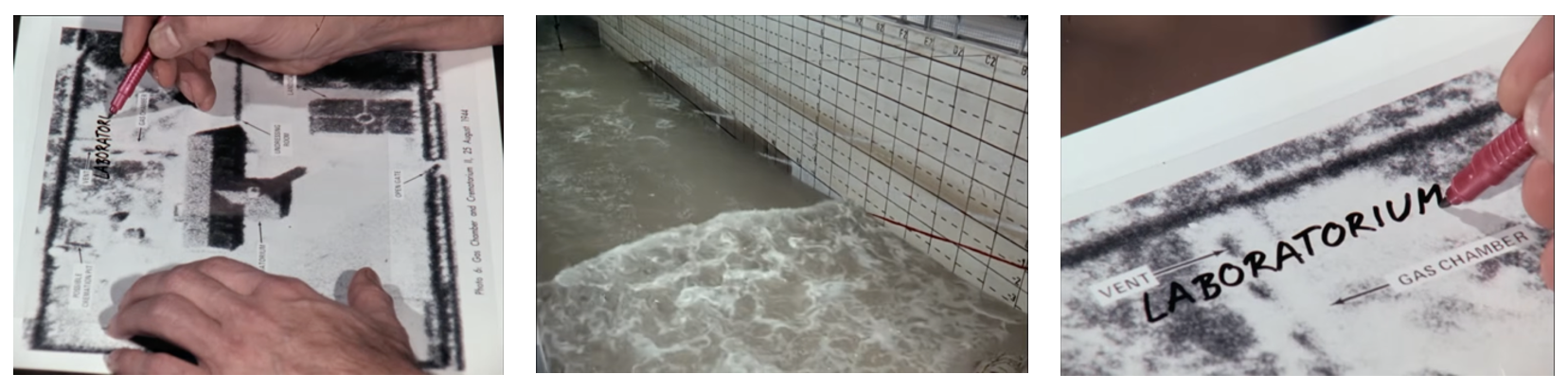
We hear the following: “Hannah Arendt wrote that the concentration camps were laboratories. ‘Laboratories, in which experiments were carried out, to see whether the fundamental claim of totalitarian systems that human beings are capable of being totally dominated is correct. Here the question was to establish what was possible at all and to obtain proof that absolutely everything is possible.’”
Arendt’s thought from The Origins of Totalitarianism, published in German in 1955, can be read as a commentary on the AfD’s election campaign in Saxony-Anhalt, which ended a few days ago with the party securing 43.8 percent of the vote. On the stage above Ulrich Siegmund’s head, in capital letters: EVERYTHING IS POSSIBLE. The period at the end of the sentence is part of the slogan. On large posters along the roadside and smaller ones on lampposts: “It starts here. Everything is possible.” At campaign booths in Halle, Magdeburg, or Lutherstadt Eisleben: “No tax on pensions! Everything is possible.” – “Everything is possible,” often without any further clarification of its meaning, was the AfD’s mantra during the election campaign in Saxony-Anhalt.
At first glance, the phrase comes across as a promise. “The best schools in the world. Anything is possible.” It conjures up a world in which school education is excellent and pensions are tax-free. What could one possibly object to?
The statement “It starts here” comes across as even more aggressive, emphasizing a break with the past. A new era is being proclaimed, in which Saxony-Anhalt is to be the starting point for what is beginning here and now and will spread to other states and ultimately to the federal government. In other combinations of phrases, “Everything is possible” ultimately comes across as an overt threat. “Our state. Our culture. Everything is possible.” – “Chase the bureaucrats off the farmland. Anything is possible.” – “A state without illegals. Anything is possible.” The term “illegals” does not refer to one of the AfD’s direct candidates, who has been convicted multiple times for document forgery and theft and is now entering the state parliament with an election result of nearly 44 percent, despite his sentences on probation. The threat is aimed at asylum seekers, migrants, or simply “others” who do not fit into the fiction of “our country” and “our culture.” Particularly blunt: “Deportations from minute one.”
“Anything is possible”—for Hannah Arendt, this is the core of a totalitarian idea of what is feasible: If anything is possible, no boundaries apply anymore — not those of the rule of law, not those of humanity, not even the simplest rules of mutual solidarity. It’s only logical, then, that “feasibility entrepreneurs” like Elon Musk immediately sent their congratulations to Magdeburg on election night. “Muskism” as practiced totalitarianism of possibility in terms of space, time, and imagination: Life on Mars – everything is possible. Overcoming death — anything is possible. AI — anything is possible. The emancipatory potential of the possible — as it ranges from Musil’s “sense of possibility” through conceivable “spaces of possibility” to Alexander Kluge’s “subjunctive of images” — is destructively overwritten; utopia becomes dystopia.
Alongside Hannah Arendt, Günter Anders is a second important point of reference in Images of the World and the Inscription of War*. The philosopher reflected on the extermination camps as well as on the dropping of the atomic bomb. Both events exceed the limits of human imagination in their scale. Little remains today of what Anders called “Promethean shame” in the face of these planetary forces of destruction. The hubris of “Everything is possible” is more indicative of Promethean shamelessness. Is it defeatism or pathos to ask: Can what is possible still be saved? Is salvation possible?
September 10th, 2026 — Rosa Mercedes / 06