Images after Seeing Everything. A Visual Essay
by
The Apocalypse of optics is an eyewitness to the Apocalypse (Jean François Niceron, inscription in Greek on his anamorphic mural painting: “Saint John the Evangelist writing the Apocalypse on the island of Patmos”, Trinità dei Monti, Rome, 1642)
Now there’s a lot that one can say about the war, but I want to say something that doesn’t have to do with operations or tactics, or strategy or politics. I want to say something just about the moral dimension of all of this. When you’re sitting in a city or a town or in the countryside, and someone is lobbing missiles in your direction from hundreds or thousands kilometers away, sure, there’s a physics to that, and there are many ways to talk about it. But I just don’t think you can get out from under the moral dimension of all this. And the moral dimension is cowardice. It’s cowardly to fight wars like this. I mean, in some deep sense it is cowardly to fight most of the wars that people are fighting. The offensive ones, I mean, from a distance. But there’s something quite specifically cowardly about being the person who pushes the button, but doesn’t see the missile going through the air. Who doesn’t feel the consequences of it landing. Who, unless something exceptional happens, is perfectly free of all the consequences of all this. I don’t think that situation can be described completely or adequately without the moral dimension. And the moral dimension is the cowardice. (Timothy Snyder, “Kharkiv Meditation 1/10”, September 21, 2026)
…It’s a horrible thing, and that is religious Zionism – a cult of death eaters.
(Adi Angert, Mental health officer of the IDF’s Alexandroni Brigade, X, August 26, 2024)
Der Krieg ist wie die Liebe, er findet immer einen Weg. (Bertolt Brecht, Mutter Courage und ihre Kinder, 1939)
The political theology and political economy that are enmeshed in the Israeli war state are grounded in biblical commandments and cutting-edge technologies – their vectors merge into a hellish dynamic that encompasses manic prophesizing and creative military technologies. Many of the images in the following visual essay are from the West Bank where Palestinian farmers are currently being driven from their land during the olive harvest. Since Palestinian residents of the West Bank have been barred work from working in Israel for nearly a decade, olive cultivation and other agricultural activities have become the sole means of livelihood for many Palestinians. State-backed gangs of settlers terrorize them – burning their crops, poisoning and steeling their sheep, brutalizing and killing them.
What follows is intended as a brief visual essay on the current state of affairs in Israeli society, or whatever is left of it, in the run-up to the October 27 elections. The material comes primarily from social media and instant messaging platforms. The painter Shay Yehezkelli recently stated that Israelis do not see, do not want to see and cannot see: “After the last few years, in which many of us absorbed an overdose of visual pornographic mutilation of the human body – years in which the human was cheapened, disfigured into its internal and external organs and was exposed to anyone.” Yehezkelli says that those that have already seen it all can now only tolerate mechanistic diagrams. This is a very suggestive way to look at the images here – lens based as well as AI generated. They are less representational than they are demonstrative. They address the fact that the reality in Israel-Palestine is both exceptional and exemplary.
Almost two decades ago, both Ariella Aïsha Azoulay and Eyal Weizman, immense figures in the contemporary intellectual field and Israelis by birth, conceptualized and devised their respective protocols for retrieving images and investigating the conditions of possibility for these images to emerge. Azoulay’s The Civil Contract of Photography (2008), proposed an elaboration of Hannah Arendt’s “space of appearance,” wherein photography becomes a realm constituent of a new civil contract. Weizman’s work at the Center for Research Architecture at Goldsmiths, where, together with students, he formed Forensic Architecture as a research group in 2010 [first conceptual products were presented in Issue 43 of Cabinet Magazine (2011)], devised tools for retrieving images where there were none. Both projects focused on seeing as a means to reconstruct a possible forum or citizenry that would undo the absolute grip of the Israeli occupation of the West Bank and Gaza, the context from which they stemmed.
Azoulay’s and Weizman’s projects were very different of course, but they have gained recognition in fields beyond specific legal activism in the occupied Palestinian territories. These projects recognized that international law and world news organizations were unable and unwilling to provide protection for civilians under what has already then amounted to over four decades of military occupation and sixty years of expulsion.
Azoulay’s project was to delineate a form of “citizenry” that overcomes the blind spots of international human rights laws, through photography – “a citizenry without sovereignty, without place or borders, without language or unity” (The Civil Contract of Photography, 14). Weizman’s project was to find evidence in an opaque legal system governed by martial law. Forensic Architecture’s first investigation took place as part of the legal efforts by Israeli human rights lawyer and activist Michael Sfard to secure justice for Bassem Abu Rahma who was 30 when he was killed in a non-violent demonstration in Bil’in, on April 17, 2009. The evidence they gathered was intended to be presented to the Supreme Court in Israel.
At the same time, both Azoulay’s and Weizman’s projects explored the conditions of possibility for an image to emerge – for Forensic Architecture that meant developing tools for synchronizing sources of sound and images, satellite and cellphone footage, plans and geological surveys, testimonials and heat tracking, location triangulation and many other forms for visualizing that which cannot be seen. In a reverse of Julio Cortázar’s 1959 story “Las babas del diablo” and the celebrated film which adapted its plot, Michelangelo Antonioni’s Blow Up (1966), Forensic Architecture would find evidence which was not caught on camera in one frame. Coinciding with the emergence of open-source intelligence, when citizen journalism and WikiLeaks established the dissemination of public and clandestine information online, Forensic Architecture processed materials for a future forum of truth and justice. As Weizman described it in Forensis: The Architecture of Public Truth (2014, 9): “Forensis, as we employ the term, seeks to bring new material and aesthetic sensibilities to bear upon the legal and political implications of armed conflict, struggles for justice and climate change.” The mission was to extend forensic investigation beyond existing courts – whether state bound or internationally contained –, creating new public forums in which evidence can be presented and political accountability demanded.
Before the formation of Forensic Architecture, Azoulay curated an exhibition in 2004 titled Everything Could Be Seen, in the Umm El-Fahm Municipal gallery, the biggest Arab city in Israel. This exhibition presented visual materials and artworks that have been conceived, collected, classified, created or processed as evidence for a future tribunal on the continuous reality of Palestinian life under Israeli occupation.
Looking back at these two canonical projects against the backdrop of the reality of genocide and through the prism of social media and slopaganda in an environment saturated by fascist cruelty – both visual and political – one can acknowledge Azoulay and Weizman as guides to the imagination ensued by looking through the following collection of images. The development of a political philosophy of the image in relation to Israel-Palestine has a long history. Susan Sontag’s 1974 film Promised Lands, which juxtaposes the voices of two Zionist currents against the backdrop of the Sinai carnage of the 1973 war and Palestinian life under Israeli occupation in the West Bank; Pier Paolo Pasolini’s 1963 visit to Israel and Jordan in search of locations and faces for his film on the passion of Jesus of Nazareth, realizing Israel is already too modern for him; Anne Marie Miéville’s and Jean-Luc Godard’s 1976 Ici et Ailleurs deployed the media transmission at the center of Israel-Palestine with its “intolerable” associations, as Gilles Deleuze called them[1]; Michael Mrakitsch’s lesser-known Shalom or We Have Nothing to Lose (1983), which was shot in the settlements in the West Bank and in Southern Lebanon during the 1982 Israeli invasion; Godard’s 2004 Notre Musique, with Palestinian poet Mahmoud Darwish, in the lobby of the Sarajevo Holiday Inn (reenacting an interview he gave in 1996 to Israeli literary editor Helit Yeshurun in Amman), in which he says: “[…] we have the misfortune of having Israel as an enemy because it enjoys unlimited support. And we have the good fortune of having Israel as our enemy because the Jews are the center of attention. You’ve brought us defeat and renown.” The film includes Godard’s famous “shot/reverse-shot” lecture scene, where he states: “The Jews become the stuff of fiction: the Palestinians, of documentary”. And the long lost Palestinian-Jordanian fiction film Struggle in Jerash (directed by Wasif Alshaikh, 1957), which artists Eileen Simpson and Ben White re-animated in 2008 by interviewing people who have had a relation to the film or to the production, adding a contemporary audio channel to it. The space of Israel-Palestine itself is re-animated in the film as back then, Jerusalem was only a short car drive away from Amman since they were both part of the kingdom of Jordan. The film’s imaginative capacity links it to this list of films that juxtapose images to find a relationship that articulates the rupture that is Israel – from old masters’ biblical paintings and interviews with locals living in those supposed locations, to perpetrators and victims transmitted through mass media networks of sound and image.
My own compilation of images here is mainly from the West Bank – it shows some “intolerable” associations made by the historical actors themselves – for example the Hamas October 7 armed white pick-up trucks invading Israeli Kibbutzim, and similar white pick-up trucks with armed Israeli settlers descending on Palestinian villages in the West Bank in the summer of 2026. The images are taken by perpetrators and by advocates of protective presence, Israelis and international activists who come to the aid of Palestinian farmers who are constantly being attacked in their homes and fields. The first batch is a collection of social media material that found its way to my phone and computer. Some images seem to attempt to demonstrate a kind of strategic or moral superiority in seemingly irrelevant contexts like a children’s show, a sketch on a napkin, drawings of a portrait of Adolf Hitler in the possession of a private individual in an illegally occupied territory of the sovereign state of Lebanon, and so on. The images present themselves at the heart of a project of violence as a process of education and self-education. In a borderless country, violence marks a boundary at every moment – on any literal body, in everyone’s retina – while at the same time constantly expanding the state’s capacity for violence.
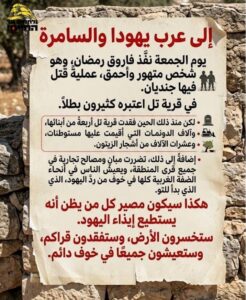 An AI-generated letter in Arabic, posted by settlers, in which Palestinians in the West Bank are threatened and referred to as “temporary residents”. Summer 2026.
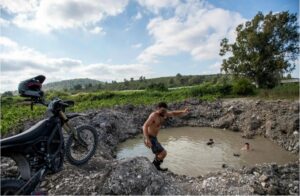 A recreational pond frequented by Israelis. It was created by an interceptor missile fired at an Iranian missile just outside Jerusalem. Spring 2026
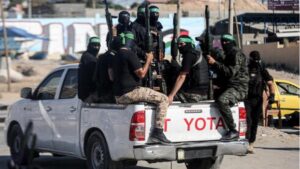 An Hamas pickup truck on October 7, 2023 descending on Israeli towns,
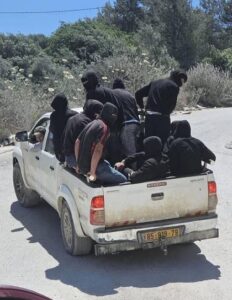 and its doppelganger – Israeli settlers in the West Bank in the summer of 2026.
 Dessert festival in Petach Tikva. An ad for a show at a shopping mall featuring an established, popular singer (middle), a children’s TV character in a monkey costume, and an up-and-coming ballad singer and reservist whose stage costume consists of his gear as a member of an undercover “counter-terrorism” unit.
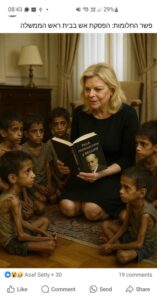 A caricature in the style of John Heartfield, created by artist Lior Waterman using AI, depicting the wife of the Israeli prime minister, Sara Netanyahu, at the official residence, reading Sigmund Freud’s The Interpretation of Dreams as a bedtime story to Palestinian children during Israel’s targeted starvation campaign in Gaza. March 2024.
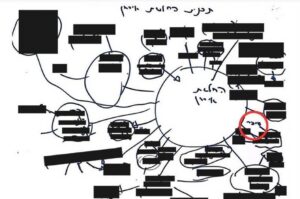
Naftali Bennett, a former PM and politician who is challenging Netanyahu for the office of prime minister, posted his elaborate “plan” to topple the regime of the Islamic Republic of Iran (the redactions are from the original image posted on Facebook). The title reads “A plan to weaken Iran”, and the writing in the big circle says “Weakening Iran”, while the writing in the small red circle says “Cyber”); the rest is blacked out. July 1, 2026. In a lengthy post Bennett wrote: “Take a look at this document; I wrote it during a security discussion regarding Iran in January 2022, while I was serving as Prime Minister. I conducted an in-depth study and learned that there is a range of ‘soft’ measures that can be taken to amplify the regime’s vulnerabilities. The document I wrote details dozens of avenues for action aimed at toppling the Iranian regime through indirect means—military, technological, diplomatic, and economic—both overt and covert. Most of the content is redacted, for obvious reasons. […] We need a grand strategic plan regarding Iran – one that restores the initiative and the element of cunning to Israel – and we need an equally ambitious plan to strengthen Israel from within. This is the mission of our generation. It will happen soon. I am optimistic. With God’s help, we will take the initiative, we will grow stronger, and we will win.”
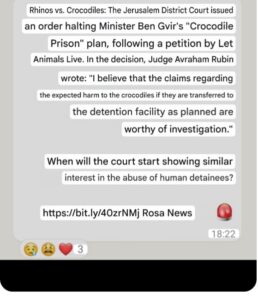
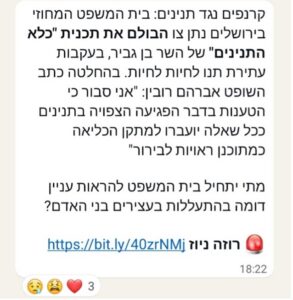 A screenshot from Hebrew-language socialist news service Rosa Media, reporting on a court ruling in Jerusalem that halted National Security Minister Itamar Ben-Gvir’s plans to build a crocodile moat around the prison for Palestinian political prisoners. In Israel, a special permit is required to keep crocodiles in captivity, as they are classified as wild animals. The court’s intervention was based on concerns regarding the well-being of the crocodiles. The news service titled the article “Rhinos vs. Crocodiles,” described the judges’ concerns as “crocodile tears” and referred to the judges as rhinos, since in Israeli culture, drawing on Eugène Ionesco’s play.
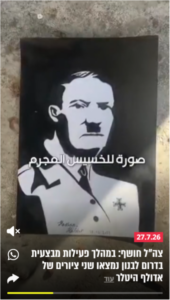 A video posted on social media by the Israeli military spokesperson in Arabic, in which she announced that the IDF had found two sketches on paper by Adolf Hitler in villages it occupied in southern Lebanon. July 27, 2026: https://www.mako.co.il/breaking_news-2026/m07_w05/shorts-28305ff7a23af91027.htm
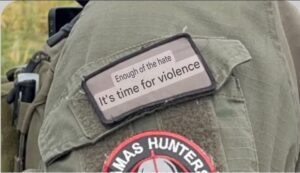
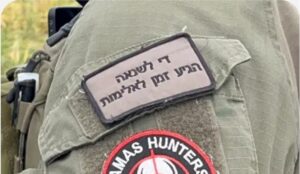 A seemingly cryptic military patch that some Israeli military soldiers choose to wear, which reads: “Enough with the Hate. It’s Time for Violence”. Summer 2026. In the Israeli context, the message suggests overcoming internal political polarization (“enough with the hate”), by inflicting punitive violence on the Palestinians (“It’s time for violence”).
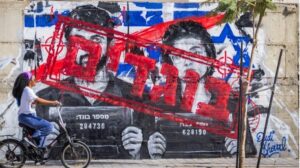 A mural in in the city of Ashdod by Dudi Shoval depicting the filmmakers of the documentary NAZA, Rachel Szor and Yuval Abraham, portrayed as if they were being taken into custody following their arrest. Behind them is what appears to be an Israeli flag. The word “traitors” is smeared across their faces in red paint. October 2026. NAZA centers on interviews with soldiers, who have been involved in the bombing of Gaza since October 2023. They are sharing their routine work with AI system Lavender and the calculation of “collateral damage”, which has led to the deaths of tens of thousands of Palestinians. The film was not shown in Israel but was labeled “anti-Semitic” by local pundits.
While I was gathering materials for this visual essay, the fashion house Comme il faut, released its fall 2026 campaign. Its founder and CEO, Sybil Goldfainer, is an activist who participates in protective presence actions in the West Bank, where she shields Palestinian farmers in the Jordan valley from the daily pogroms and attacks by settlers who invade their villages and land. Goldfainer has a collection of photographs documenting her encounters with young, violent settlers in government-funded off-road SBS buggies, as well as the sheep and soldiers accompanying them. Here are a few of them:
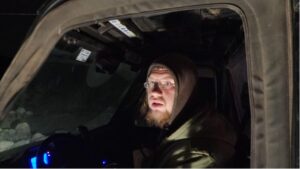
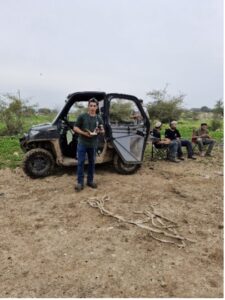
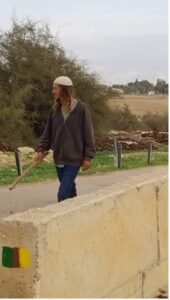
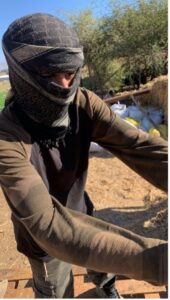
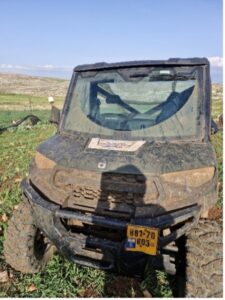
 Photos by Sybil Goldfainer
The Comme il faut campaign is made up of a series of images generated in AI amalgamation on Nano Banana Pro via a text-to-image process. Photos by Goldfainer and editorial shots of the brand’s clothes served as templates. In addition, the AI image generator was tasked with depicting these hill youths; to do so, it used images from the internet (there is a photographer who has made a celebratory series dedicated to these young violent settlers, titled “Pioneers”, who is suing Comme il faut for unlicensed use of his work).
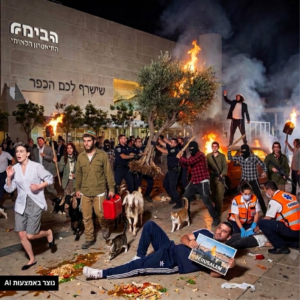 The scene takes place next to the national theater Habima in Tel Aviv, where anti-government rallies and demonstrations have been gathering since the COVID pandemic (it replaced Rabin Square, the site where its namesake, PM Yitzhak Rabin, was assassinated). The image shows men with balaclavas and wooden clubs, paramedics attend to a person on the ground, a goa, cats and food on the floor. A model with grey suite is running away. Behind her, a military clothed settler with a red plastic jerrycan which is usually used for carrying highly flammable gasoline. The graffiti on the building reads “May Your Village Burn” which has become a genocidal chant in soccer stadiums and stands for “Death to the Arabs”. The black stripe in the lower left says: “Made using AI”.
In a blog post, Goldfainer explained the campaign to her clients, upper-middle-class women. She explained that there is a place an hour away from the Tel Aviv’s commercial center where “hundreds of criminals – teenagers aged 14–18 and adults – roam freely.” They revel in their cruelty and impunity and are armed with clubs and knives, while the adults carry weapons issued by the IDF. They travel in dozens of all-terrain vehicles (ATV) and subject Palestinian residents to severe violence on a daily basis. “These criminals are never arrested, nor even questioned — not for setting homes on fire, not for inflicting bodily harm, and not for shooting or killing civilians. On the contrary, they are embraced, supported, and valued by the state, and receive significant financial backing.” The intertwining of Goldfainer’s commercial fashion business and the reality she reports on, daily abuse, harassment, humiliation, and brutal violence, matches with the format she devised using an AI image generator.
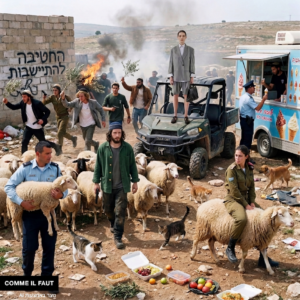 This scene is set in the West Bank: A female soldier and male policeman are playing with sheep and having a soft-serve ice from an ice cream truck. A dog, cats and food lying on the ground can be seen. A model in a gray suite is standing on an ATV. This image sparked a lawsuit and and as a result significant media attention. The graffiti on the wall to the left was created by the AI generator. It reads: “The Settlement Division”. This refers to a department within the World Zionist Organization, which is now suing Comme il faut. By scouring the internet, the AI generator established a connection between complicit law enforcement, the burning of olive trees and the “Settlement Division.” The linkage exists as an infrastructure that the AI generator uncovers.
In a recent essay, titled “Image Thinking After Artificial Intelligence”,[2] the authors Yanai Toister and Joanna Zylinska argue that AI generated images not only change the way we see but that we should view them as part of the process of cultural production. They situate AI’s ability to generate an image from a concept within the discourse of visual culture and not exclusively within the confines of computer science. Referring to Aby Warburg, Vilém Flusser and WJT Mitchell, they assert: “Latent space, the mathematical core of generative AI models, is not a vault of images but a vectorized map of visual potential.” (446). This realization relates directly to the lawsuit by the Settlement Division. As Toister and Zylinska put it: “[…] generativity lies not in their resemblance to the real, but in their capacity to instantiate the unrealized – to visualize thought experiments, metaphors and counterfactuals.” (447). Goldfainer writes to her clients: “This is ethnic cleansing — deliberate and orchestrated. When I am in the field, the dots connect: the authorities provide backing and support—distributing firearms, all-terrain vehicles, and funding, while legitimizing outposts and farms.” The criminal youths are but proxies of the government.
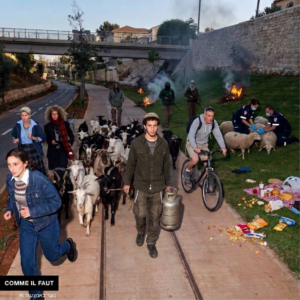 This scene shows masked paramedics tending to sheep, armed youths whose religious apparel is recognizable by its tassels while a keffiyeh covers their face, and a shepherd accompanied by goats and holding a propane tank. A cyclist stands next to a picnic mess with snacks scattered all over the floor. The scene takes place in Tel Aviv’s most gentrified neighborhood. The old Ottoman railroad tracks from Jerusalem to Jaffa are now a park with cafés and jazz bars, upscale restaurants and music venues. Joggers go there for their evening runs. In this photo, its women who are running away.
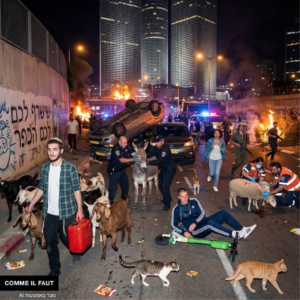 This image is located at an exit on the Ayalon Bypass in Tel Aviv. Here too, the graffiti “May Your Village Burn” is visible. Once again, a youth with a red plastic jerrycan, followed by goats. An e-bike rider in an Adidas tracksuit is lying on the ground. A donkey is being tended to by police officers, while paramedics care for injured sheep. Behind them are police cars, burned-out cars, and cars piled on top of one another. In the background, the skyline of Tel Aviv’s business district.
Goldfainer concludes her open letter: “The campaign we present here is not dystopian — because the dystopia is already here. An hour away from us, an atrocity is unfolding, and we must use every tool at our disposal to resist it. For many years, I was aware of the situation from afar; in recent years, I have begun to look at the occupation in the eye. I invite you to join us in acts of “protective presence” on the ground, or to support our volunteer efforts in other ways.” The proposition to “look to the occupation in the eye” through an AI image generator proves to be a brilliant and loaded gesture. It is an unveiling, an apocalypse in the literal sense. And here, as in Baroque anamorphic images that target the eye itself, the apparatus of optic manipulation that is the AI composite image aggregation is the eyewitness to the apocalypse.
Far removed from the potentials of photographic “citizenry” and public forums of truth, which we have yet to produce successfully, this gesture is, paradoxically, nonetheless connected to the projects of Azoulay and Weizman projects from a decade and a half ago. These images propose an architecture of public truth at a political and visual moment in which both the public sphere and truth itself are being decimated. Similar to John Heartfield’s photomontages, the composite image created here demonstrates the truth. Toister and Zylinska describe it as: “the interplay of surface and pipeline, sign and circuit, tracing how invisible infrastructures of statistics and calculation co-author the visible manifestations of thought” (448). Here, demonstrative mechanistic diagrams of an AI generated imagery provide an apocalypse – an unveiling, revelation – and enable us to look to our catastrophic reality in the eye.
* * *
Perhaps the hermetic environments, saturated by fascist cruelty – both visually and politically – can once again be best conveyed through cinema. Robert Bresson’s A Man Escaped (Un condamné à mort s’est échappé ou Le Vent souffle où il veut, 1956), famously tells the story of of resistance fighter André Devigny’s (1916-1999) escape from the Gestapo prison at Fort Montluc in Lyon in 1943. At that time, part of France was under Nazi occupation. The film depicts in detail the meticulous actions and movements of the character Fontaine (played by François Leterrier) as he is gradually gathers tools and uses them to escape. Throughout the film, we see his face and hands – as long as he strive to be free, seeks freedom and turns that desire into action it, he is a free man. Together with the young François Just (Charles Le Clainche), they finally manage to escape from – though only into Nazi-occupied France.
On September 6, 2021, Zakaria Zubeidi and five members of Islamic Jihad carried out the most notorious prison break in recent Israeli history from the high-security Gilboa prison in the north of the country. They were captured five days later. Zubeidi was a high-profile Palestinian militant leader who, as a child, appeared in the 2004 film Arna’s Children by late Palestinian-Israeli actor Juliano Mer-Khami which documented the theater run by Mer-Khami’s Jewish-Communist mother in the Jenin refugee camp, where Zubeidi grew up. Later, as chief of the Al-Aqsa Martyrs’ Brigades, an armed faction close to Fatah, Zubeidi was arrested along with his then-Israeli girlfriend Tali Fahima, who later denounced him and converted to Islam in 2010. Zubeidi was released and turned to cultural work with Mer-Khami and the Freedom Theater in Jenin. He was later arrested again, and his escape became the subject of a 24/7 TV manhunt, which detailed an enedeavor similar to Bresson’s Fontaine – he and his comrades dug their way out using sharpened spoons. The moment Zubeidi was captured, exhausted and thirsty, in a cave was a heart-wrenching moment of realization: There is no escape; there is no outside to the prison.
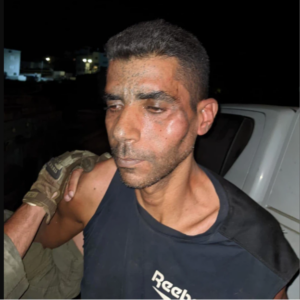 Zakaria Zubeidi caught. 11 September 2021.
Notes
[1] “It can, in fact, always be objected that there is only an interstice between associated images. From this point of view, images like those which bring together Golda Meir and Hitler in Ici et ailleurs would be intolerable. But this is perhaps proof that we are not yet ready for a true ‘reading’ of the visual image. For, in Godard’s method, it is not a question of association.” Gilles Deleuze, Cinema 2: The Time-Image, trans. Hugh Tomlinson and Robert Galeta, London & New York: The Athlone Press, 1989, 179–180.
[2] Yanai Toister and Joanna Zylinska, “Image Thinking After Artificial Intelligence,” Journal of Visual Culture, Vol 24, Issue 3, December 2025, 431–451ch
October 30th, 2026 — Rosa Mercedes / 07