Mai 2025: Louis Skorecki: Qui est Farocki? (#95)
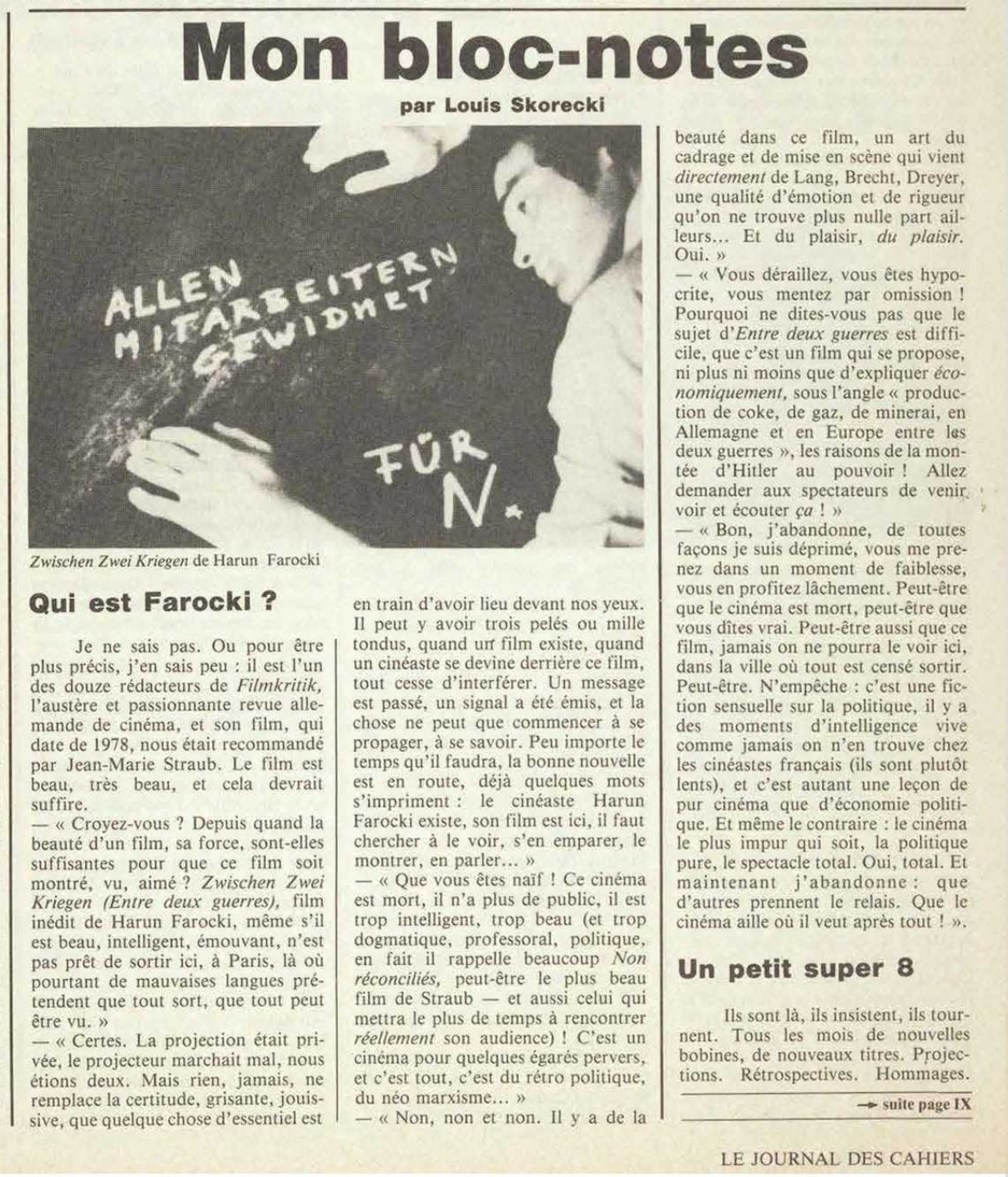
Louis Skorecki’s short imaginary dialogue about Farocki’s BETWEEN TWO WARS has been quoted many times. It was published in No 329 (November 1981) of the CAHIERS DU CINÉMA, but not in the main part of the issue, but in “Le Journal des Cahiers du cinéma” (No. 18), a supplement to the journal. Here’s the English translation:
Who is Farocki?
I don’t know who he is. Or to be more precise, I don’t know very much: he’s one of the twelve editors of Filmkritik, the austere and fascinating German film journal, and his film, which dates from 1978, was recommended to us by Jean-Marie Straub. The film is beautiful, very beautiful, and that should be enough.
– “Do you think so? Since when is the beauty of a film, its strength, enough for it to be shown, seen and loved? Harun Farocki’s unseen film ZWISCHEN ZWEI KRIEGEN (BETWEEN TWO WARS), however beautiful, intelligent and moving, is not about to be released here in Paris, where malicious tongues claim that everything can be seen and seen.”
– “Certainly. The screening was private, the projector malfunctioned, there were two of us. But nothing ever replaces the exhilarating certainty that something essential is taking place before our very eyes. There may be three peelers or a thousand shearers, but when a film exists, when a filmmaker is behind it, everything stops interfering. A message has been sent, a signal has been sent, and the thing can only begin to spread, to be known. No matter how long it takes, the good news is on its way, and a few words are already being printed: filmmaker Harun Farocki exists, his film is here, and we must try to see it, get hold of it, edit it, talk about it…“
– ”How naive you are! This cinema is dead, it no longer has an audience, it’s too intelligent, too beautiful (and too dogmatic, too professorial, too political, in fact it reminds us a lot of NOT RECONCILED, perhaps Straub’s finest film – and also the one that will take the longest to really find its audience)! It’s a cinema for a few perverse misguided people, and that’s all, it’s retro politics, neo-Marxism…“
– “No, no and no. There’s beauty in this film, an art of framing and staging that comes directly from Lang, Brecht, Dreyer, a quality of emotion and rigor found nowhere else… And pleasure, pleasure. Yes.”
– “You’re off the rails, you’re hypocritical, you’re lying by omission! Why don’t you say that the subject of Between Two Wars is a difficult one, that it’s a film that sets out, no more and no less than to explain economically, from the angle of coke, gas and mineral production in Germany and Europe between the wars, the reasons for Hitler’s rise to power! Go and ask the audience to come and see and listen to this!”
– “Well, I give up, I’m depressed anyway, you catch me in a moment of weakness, you take cowardly advantage of it. Maybe cinema is dead, maybe you’re right. Maybe we’ll never be able to see this film here in the city where everything’s supposed to come out. Maybe… Nonetheless: it’s a sensual fiction about politics, there are moments of lively intelligence the likes of which you’ll never find in French filmmakers (they’re rather slow), and it’s as much a lesson in pure cinema as in political economy. And even the opposite: the most impure cinema there is, pure politics, total spectacle. Yes, total. And now I give up: let others take over. Let cinema go where it will after all!”
May 8th, 2025 — Archive / Showcase